Dismantling the Studio-Volume Test for Authorship
Evaluating a filmmaker's distinct visual language requires an understanding of how critical frameworks shape historical memory. Auteur writing from approximately 1954 to 1962 treated a director’s claim as proven by a continuous studio-assignment run. This specific metric relied on the machinery of the studio system, where prolific output served as the baseline for critical legitimacy. Authorship tests that count studio-assignment volume split a woman director’s independently financed calendar into ‘complete’ and ‘interrupted’ piles her films never occupied. The critical establishment demanded a rapid succession of projects to validate a director's signature style.
Feminist film criticism from somewhere around 1975 to 1983 recast sporadic production calendars as a legitimate object of stylistic tracing. Critics began to examine the spaces between productions as active periods of creative development and financing strategy. This shift in perspective allowed analysts to view a sparse filmography as a cohesive body of work rather than a series of disconnected efforts. The focus moved toward the deliberate choices made within each hard-won production.
Where archival programming notes from 2019–2024 detail exhibition shifts, career-spanning retrospectives replace isolated premiere slots. Modern curation honors the sustained effort required to build a cinematic legacy outside the traditional studio apparatus. Programmers now present these filmographies as complete narratives, highlighting the thematic through-lines that persist despite decades-long gaps between features. This approach provides audiences with a comprehensive view of a director's evolving craft.
Clustering Films by Structural Challenges
Mapping a director's evolution demands a deliberate approach to the viewing schedule. A strict date-ordered pass flattens thematic clusters that sit three to seven years apart. Analysts discard this chronological method early in the process, choosing instead to group films in 3–5 title clusters based on shared structural problems. These challenges often include managing ensemble interiors, sustaining road-picture duration, or integrating documentary inserts into narrative fiction. Watching these specific clusters back-to-back reveals how a director refines her problem-solving techniques over time.
Tracking recurring cinematographers and editors across 4–8 year gaps between features exposes the foundation of a director's creative ecosystem. A filmmaker relies on these trusted collaborators to translate her evolving vision into tangible sound and image. Identifying these partnerships helps analysts understand how a specific visual rhythm develops across multiple productions. The continuity of the crew often provides the stylistic glue that binds disparate projects together.
This structural approach to viewing highlights the progression of narrative complexity. A director's handling of a multi-character scene in an early, tightly budgeted feature informs her approach to massive set pieces decades later. By isolating these structural similarities, programmers can articulate the specific mechanics of a filmmaker's growth.
Isolating Visual Rhythms and Thematic Anchors
A director's unique cinematic language often announces itself in the earliest moments of a film. Doorway two-shots and held wide masters concentrate in opening reels of 8–12 minutes. These initial framing choices establish the spatial rules of the narrative world. The pacing rhythms become apparent as cutaways linger 4–7 seconds past on-screen action. This deliberate lingering forces the audience to absorb the emotional resonance of a scene before moving forward.
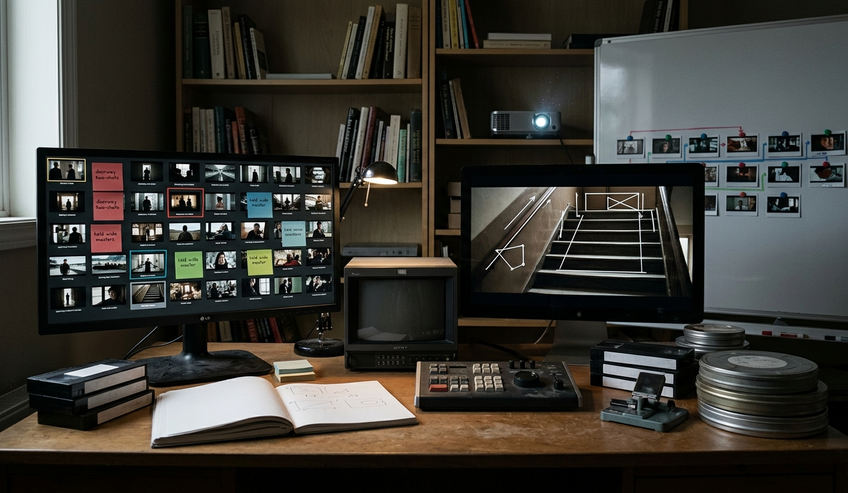
Thematic continuity requires careful tracking across significant temporal and generic shifts. Analysts check this continuity across a 6–11 year gap between a chamber drama and a later genre picture. Core preoccupations—such as isolation, systemic power dynamics, or fractured memory—persist regardless of the specific narrative format. A director might explore the same fundamental question through a quiet domestic story and a high-stakes thriller.
Independent filmographies require separating a director’s chosen frame from a shot that exists because the production could not afford coverage or because a financier dictated a recut. Analysts must identify the stop-line where a held wide master ceases to be her language and is only the coverage a low-budget independent shoot could buy. Distinguishing between a deliberate aesthetic choice and a practical compromise forms the core of rigorous stylistic analysis. This careful parsing ensures that the resulting profile accurately reflects the director's true intent.
Sourcing the Unfiltered Debut Short
The purest distillation of a filmmaker's artistic voice often resides in her earliest, lowest-budget projects. Student and debut shorts of 8–22 minutes serve as the unfiltered control sample for stylistic analysis. These early works exist before the pressures of commercial viability and producer notes begin to shape the final cut. Tracing feature DNA backward involves matching lens choices, blocking patterns, and sound bridges from these initial experiments into the later, critically acclaimed films.
A Super 8 student project frequently holds the foundational visual vocabulary that a director will spend a lifetime refining. Locating these rare materials requires specific archival research methods, as these films rarely appear on mainstream streaming platforms. Researchers must navigate the complex logistics of physical media preservation to access these crucial early works.
Institutional archive partnerships facilitate access to rare materials, operating strictly within the 48–72 hour loan windows required for DigiBeta transfers. The physical reality of this research demands precise scheduling and coordination. Special-collections reading rooms typically require booking 10–14 days ahead. The effort invested in securing these early shorts pays dividends by providing the essential baseline for understanding the director's entire career trajectory.
Drafting the Career-Spanning Profile
Synthesizing weeks of viewing notes into a cohesive narrative requires a structured approach to the data. Profiles are drafted after a viewing and note-taking cycle of more or less 6–9 weeks. This extended period allows the analyst to absorb the full weight of the filmography and identify the subtle shifts in craft that occur over decades. The resulting documentation must honor the complexity of the filmmaker's journey.
Writers use career-phase headings in place of a single through-line sentence. This organizational strategy allows for a nuanced discussion of how a director's style adapts to different phases of her life and career. Reducing a lifelong body of work to a single, easily marketable narrative strips the filmography of its inherent friction and vitality. The profile must reflect the reality of the independent filmmaking process.
Project gaps of something like 3–7 years are treated as production friction rather than inactivity. These periods represent intense phases of script development, financing struggles, and the logistical challenges of mounting an independent production. Acknowledging this friction provides a more accurate and respectful portrait of the director's commitment to her craft. When you look at the gaps between a director's projects, do you see a pause in creativity, or the hidden, necessary friction of an artist fighting to maintain her voice?