A Festival Pass Buys Hours That Cannot Be Replayed
A generic panel can cost an attendee the only hour when a financier, a showrunner, and a potential collaborator share the same room. The loss reaches beyond a dull conversation. Festival days are finite, and a surface-level talk consumes the same place in the schedule as a candid discussion of how a film actually gets financed, finished, or sold.
That makes the space between screenings consequential.
At Female Eye, the industry-slate filter starts with what a session can reveal: a craft method, a distribution mechanism, or a way to sustain a career as a woman director. A promotional walkthrough of a single title stays outside that brief. A film can supply the example, but the conversation must open up decisions that another filmmaker can examine and use.
The useful distinction appears in the session description. Does it promise a discussion of independent filmmaking in broad terms, or identify a decision the speakers will unpack? A room about financing becomes more valuable when it names the order of the paperwork. A craft conversation earns its place when the moderator can ask what changed between rehearsal and the finished scene.
Choosing among those rooms requires an honest assessment of the project waiting at home. A director with a finished short and an undeveloped feature needs different answers from an editor preparing a difficult assembly. The strongest schedule follows the next decision on the film. Speaker recognition can help draw an audience; a precise question gives that audience something to carry out.
Follow the Financing Panel From Incentives to the Sales Approach
The flagship production and financing room addresses a specific transition: a director has a short proof-of-concept and is preparing a first feature-length production slate. Its usefulness rests on sequence. Regional incentive stacking comes first, followed by micro-budget equity alongside grant applications, then talent packaging before an approach to sales agents.
Independent producers and completion-bond veterans bring different pressures to that sequence. Line producers who closed a budget within the previous two festival seasons keep the conversation close to recent production decisions. Hearing those perspectives together lets an attendee follow the friction between a proposed package and the work required to make it credible.
Listen for the Dependency
A trade summary can report that a film secured financing. A moderated room can ask which commitment had to arrive before the next conversation could begin. That is the detail worth catching: what the producer needed in hand, what remained conditional, and what changed when talent entered the package.
- Regional incentives: track which territorial assumptions hold the example together.
- Equity and grants: listen for how each route changes the preparation and order of the application or approach.
- Talent packaging: identify what the speakers wanted established before contacting a sales agent.
Canadian or European co-production structures need adaptation for a purely domestic US indie without a territorial partner.
For the short director entering feature development, the recommendation is concrete: leave with a sequence of unresolved decisions. A list of financing terms is easy to collect. Knowing which question must be answered before a producer can advance the package gives the next development meeting a purpose.
Watch the Decisions Between Director, Camera, and Edit
A room goes quiet over a scene breakdown. The blocking shifts, a lookbook reference comes back into view, and a department head explains the rehearsal adjustment that made the scene workable inside a compressed shooting day. This is where a craft session earns attention: the audience can follow a choice through its consequences.
The director-cinematographer and director-editor pairings receive priority because they shape both the material captured and the film that survives the cut. Their conversations expose the practical relationship between intention, coverage, and time. The useful moderator keeps returning to the scene rather than allowing the discussion to drift into statements about creative chemistry.
A precise follow-up might ask what the revised blocking allowed the camera to see, or which missing reaction complicated the edit. In a discussion of Super 8, a question about how the intended texture influenced coverage would keep attention on the filmmaking decision. The format alone supplies little practical guidance.
Sound deserves the same specificity. When a department head describes a solved on-set technical problem, the audience can listen for the consequence across departments: did the solution alter staging, require another performance choice, or leave work for the edit? Those are useful questions for the room, without assuming every production faced the same constraint.
Female Eye’s emphasis on women directors gives these exchanges a clear professional context. Within the craft sessions, the evidence of candour is the problem a speaker agrees to unpack. An attendee should leave able to describe the constraint, the adjustment, and the trade-off. Praise for collaboration carries less detail than that chain of decisions.
Use the Q&A Microphone for One Answerable Question
The screening grid determines how much conversation a room can hold. Extended moderated Q&As sit with late-afternoon documentary blocks and midnight genre blocks; other blocks receive a short stage introduction so the theatre can turn. Attendees seeking a sustained discussion should check that distinction before building their day around access to a director.
Those longer documentary and genre conversations create room to move beyond a press-kit anecdote. The moderator can stay with an answer, return to a scene, and ask what a choice cost elsewhere in the film. Even then, the audience helps determine the quality of the exchange.
A useful floor question contains one observable detail and one request. For example:
“In the kitchen scene, the camera stays with the listener after the speaker leaves the frame. How did that choice develop between rehearsal and the edit?”
The director has a scene to locate and a decision to explain. The question also leaves enough space for an unexpected answer. A long account of the questioner’s own project would use that space before the filmmaker could respond.
Keep the Turnaround Clear
The theatre turnaround runs through a 15-minute window from the credits to the next house opening. An extended conversation still operates inside a screening schedule. The floor microphone works best for a shared technical or thematic point; complex budget and festival-strategy inquiries belong at the lobby reception immediately afterward.
That division helps the whole audience. A question about a visible editing choice gives everyone an entry point. A detailed inquiry about the attendee’s own premiere commitments needs a separate exchange, where the filmmaker can choose whether to continue.
Arrive Before the Doors and Leave With Usable Notes
The twenty-minute rule starts before the house doors open. Arriving in that window gives an attendee a better chance to choose a seat near an aisle microphone or on the stage-exit side before those places fill. It also reduces the risk of landing in overflow. Access arrangements and staff directions take priority over a preferred seat.
The seat should support listening as well as speaking. A clear view of the screen matters during a blocking breakdown; an aisle position helps when a concise question is ready. Sitting near an exit never creates permission to intercept a speaker who is leaving.
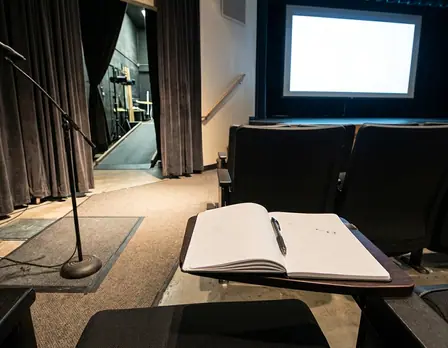
Before the lights dim, divide a notebook page into two columns. Put craft and production takeaways on the left. Reserve the right for names, companies, and follow-up triggers. The separation prevents a useful observation from disappearing into a crowded page of contact details.
A left-column note might record a change in coverage after rehearsal. Its right-column partner can identify the speaker and the question that remains. Each entry then has somewhere to go: into the project’s working notes or into a considered conversation.
Three Quotes, Still Fresh
Capture three concrete quotes and reread them within ten minutes of the session ending. Mark paraphrases as paraphrases, and use quotation marks only when the wording is secure. The immediate reread restores context while the speaker’s distinction is still clear.
Phone audio is a poor substitute for that selection. Where recording is prohibited, the decision is settled. Where permitted, a recording still leaves the attendee with material to search later. A short written record makes the useful detail available before the next conversation begins.
Carry One Precise Detail From the Row to the Lounge
When the moderator wraps, the stage quickly becomes crowded. Speakers may need to leave, confer with staff, or prepare for another commitment. The people in the same row offer a more natural first exchange: they heard the same distinction and may be working through a related problem.
A brief conversation can establish whether there is a shared interest without forcing an introduction into a pitch. An attendee might ask which part of the financing sequence matched the other person’s project. The answer can reveal a peer worth speaking with again, even when neither person has anything immediate to offer.
For a speaker follow-up, work within 48 hours and reference one distinction made on stage. Specificity gives the recipient a clear reason for the message. Keep any request small enough to answer, and send materials only when invited. The same approach works in the filmmaker lounge: recall the point, explain its relevance briefly, and allow the speaker room to respond.
Consider the sequence in practice. A first-time short director sits in the fourth row of a Friday morning distribution talk. Beside a sales agent’s name, she writes a remark about festival premiere clauses. On Saturday afternoon, she spots the agent over coffee in the filmmaker lounge and brings up that exact clause. The agent asks about her next film, then requests the lookbook for review. She opens her notebook to a clean page and writes down where to send it.