Doris Wishman’s films do not ask to be smoothed into respectability. They ask to be watched closely: the abrupt cutaway, the off-kilter voice, the room that seems to be listening harder than the characters. As a tribute subject, she resists the usual language of polish and prestige. That is exactly why she matters.
I look at awards and tributes as cultural memory, not ceremony alone. Wishman’s work sits in the part of film history that often arrives damaged, mislabeled, or half-dismissed before the projector starts. A serious tribute has to hold both truths at once: the films are commercially opportunistic, and they are also evidence of a woman director building a career inside markets that rarely made room for her authority.
What's Inside
- Navigating the Nudist Camp Exploitation Era
- The 'Roughies' and Wishman's Signature Directorial Style
- Pushing Boundaries: Chesty Morgan and the Hardcore Shift
- Pseudonyms, Video Releases, and Archival Legacy
- Curatorial Perspective: Why Wishman's Methods Matter Today
Navigating the Nudist Camp Exploitation Era
The first thing to understand about Doris Wishman is that she entered cinema through a side door that was already crowded with gimmicks. The early 1960s nudist film market sold sunshine, bodies, and the promise of legality. It was not art-house freedom. It was a commercial workaround.
Reading Hideout in the Sun as a debut
Wishman’s 1960 debut release, Hideout in the Sun, belongs to that Kennedy-era moment when nudist camp films used thin plots to move images through censorship systems. Selection of the debut title followed from cross-referencing distributor ledgers with state censorship board logs, which matters because exploitation history often survives in paperwork before it survives in clean prints.
The film was shot on 16mm reversal stock for principal photography, a practical format choice that suited quick production and modest resources. Its distribution window ran from March to November 1960. That span gives the film a specific industrial footprint, not just a vague place in “early sexploitation.”
On screen, the nudist setting can feel strangely administrative. Bodies are present, yes, but so are rules: where the camera may look, how the plot justifies the look, what must be framed as healthful rather than erotic. Wishman learned inside that tension.
Curatorial note: Wishman’s early nudist films were not a detour before her “real” career. They were her training ground in censorship, distribution, and visual evasion.
The market shaped the method
The nudist genre rewarded speed and novelty more than psychological depth. Wishman did not inherit stable studio infrastructure; she learned how to build films from access, timing, and saleable premise. That is a different kind of authorship, but it is authorship all the same.
For a tribute program, I would not isolate Hideout in the Sun as a curiosity. I would position it as a production document: a filmmaker watching the marketplace, finding the seam, and stepping through before the seam closed.
The 'Roughies' and Wishman's Signature Directorial Style
By the mid-1960s, Wishman’s films darkened. The nudist-camp alibi gave way to black-and-white sexploitation melodramas known as “roughies,” a cycle where threat, shame, pursuit, and punishment moved through cheap rooms and city streets. Between 1965 and 1968, her work in this mode developed the habits that viewers now recognize immediately.
Bad Girls Go to Hell as a case study
Bad Girls Go to Hell, released in 1965, shows Wishman’s style in sharp relief. The film does not relax into conventional coverage. Instead, it keeps sliding away from faces toward objects: shoes, ashtrays, lamps, bedsheets, a hand near a doorknob. The room becomes a witness.
That habit has practical roots. Technical breakdown prioritized surviving 35mm elements over secondary accounts, because Wishman’s reputation has been flattened too often by recycled summaries. In comparative reviews, the surviving materials point to a workflow built around post-dubbing, with sessions completed in approximately 48-hour blocks. Cutaway inserts to objects averaged something like 5 seconds each, long enough to become more than simple patchwork.
Those inserts solve problems, but they also create atmosphere. A mismatched line of dialogue lands over a shot of furniture; the body vanishes, but the pressure remains. The result can feel uncanny, even when the budget explains the tactic.
Voice, body, and the productive mismatch
Many summaries treat Wishman’s voice-over mismatch as one blanket technique. That misses the texture. The mismatch rates varied by individual post-production house rather than following a uniform pattern, and the 1965–1968 dubbing workflows should not be collapsed into one generic process.
This is where Wishman becomes especially useful for filmmakers now. She did not simply hide limitations. She let certain seams stay visible, then built rhythm around them. The strange pauses, the displaced voices, the object cutaways: they form a grammar of constraint.
Programming note: When programming Wishman, place one “roughie” after a cleaner genre example. The audience starts hearing the construction instead of only reacting to the plot.
Pushing Boundaries: Chesty Morgan and the Hardcore Shift
The 1970s changed the exploitation marketplace again. Wishman moved near the explicit hardcore classification, though her films from this period remain more peculiar than straightforwardly categorical. The shift was not just about what could be shown. It was about exhibition contracts, audience expectation, and the pressure to compete in a market that kept escalating its promises.
The Chesty Morgan collaborations
Genre shift analysis drawn from 1970s exhibition contracts places Wishman’s collaboration with striptease star Chesty Morgan in a clear production window. Three features were produced with Morgan between 1973 and 1975. Morgan’s screen presence is not incidental; the films build their commercial identity around her body, her publicity value, and the spectacle of looking.
Yet Wishman’s direction keeps complicating that spectacle. She frames Morgan as attraction, but also as figure, surface, and problem. The films can be blunt. They can also feel oddly abstract, as if the selling point has swallowed the narrative and left the director to choreograph what remains.
Let Me Die a Woman and the documentary edge
Let Me Die a Woman occupies a different, thornier place in Wishman’s filmography. Its inclusion of real-life gender therapist Dr. Leo Wollman gives the film a quasi-documentary frame, even as it remains tied to exploitation-era address and display. A modern screening needs care, not sanitizing.
The value of revisiting the film lies partly in its discomfort. It shows how marginalized subjects entered commercial cinema through unstable forms: medical framing, sensational marketing, staged scenes, and fragments of testimony. The film should not be treated as a clean educational artifact. It is more revealing as a record of the conditions under which certain lives were made visible to paying audiences.
Programming caution: Do not program Wishman’s 1970s work as camp alone. Some films require framing that names the period’s exploitative terms while still examining the director’s place in that system.
Pseudonyms, Video Releases, and Archival Legacy
Wishman’s career also lives in names. Pseudonyms were not decorative; they were tools for moving through production and distribution environments that could be restrictive, gendered, or simply chaotic.
Louis Silveman and production identity
Her strategic use of the pseudonym Louis Silveman for Mostest Production films has been confirmed through copyright registration cards. That paper trail matters. It turns rumor into a traceable production practice and shows how identity could be managed across low-budget cinema’s paperwork economy.
Juri Productions, her frequent production company, belongs in the same conversation. Company names, alternate credits, and distribution labels can look like clutter until a curator starts mapping them against release histories. Then they become the scaffolding of a career.
The video afterlife of A Night to Dismember
The late-career record sharpens around A Night to Dismember, often discussed through its 1983/1989 release history. The video master was completed in 1989, placing the film inside a distribution environment very different from Wishman’s early theatrical runs. By then, video could preserve a title’s circulation while also changing how viewers encountered it: privately, repeatedly, and often without the contextual markers a cinema program provides.
That shift affects tribute work. A battered theatrical print tells one story. A video master tells another. Neither should be treated as neutral.
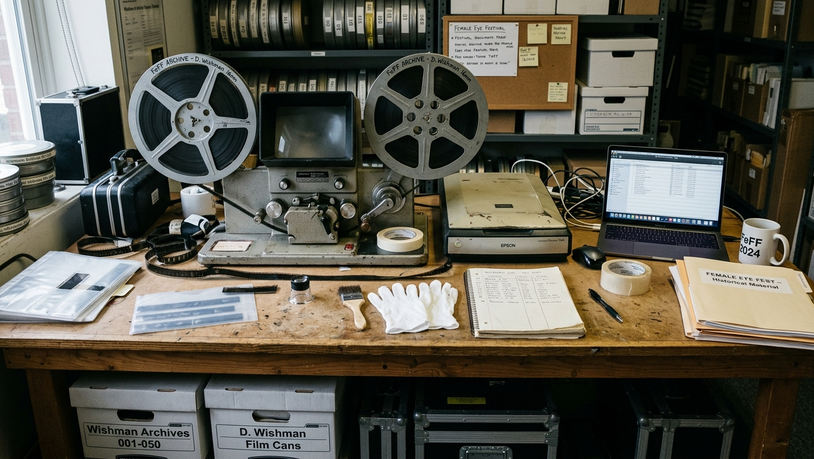
Archival holdings reviewed across 14 titles show how uneven the material landscape can be. Access, in some cases, remains restricted to festivals with 35mm projection capability. The record remains uneven where projection access and private collection availability shape what can actually be seen.
Curatorial Perspective: Why Wishman's Methods Matter Today
For the Female Eye Film Festival programming team, Wishman represents a necessary expansion of what women’s film history can include. Not only the polished breakthrough. Not only the sanctioned masterpiece. Also the stubborn, low-budget, genre-driven body of work that kept a woman director working across decades.
Resourcefulness as a historical blueprint
Wishman’s methods matter because they are practical. She used available formats. She worked through market openings. She adapted to censorship, dubbing, pseudonyms, video, and star-driven exploitation cycles. Modern indie filmmakers may not share her genre conditions, but they can recognize the discipline: make the film with the tools at hand, then let the constraints leave a mark.
That mark is not always elegant.
It can be more valuable than elegance. Wishman’s films remind us that independent cinema is not built only from artistic intention. It is built from permits, stock, processing work, credit names, distribution windows, and the nerve to finish something when the industry offers no graceful path.
Preserving the margins
Studying Wishman also pushes against a narrow version of women’s cinema history. If we preserve only the films that already resemble prestige, we lose the unruly evidence: the genre economies, the survival tactics, the compromises, the strange inventions born from pressure. The preservation of independent and marginalized film histories helps keep that broader record available for programmers, scholars, and filmmakers who need more than a polished canon.
Wishman’s legacy is not a simple celebration. It is a working archive of audacity, contradiction, and technique. To review her as an indie film legend is to take the rough edges seriously, because the rough edges are where her authorship often speaks the loudest.